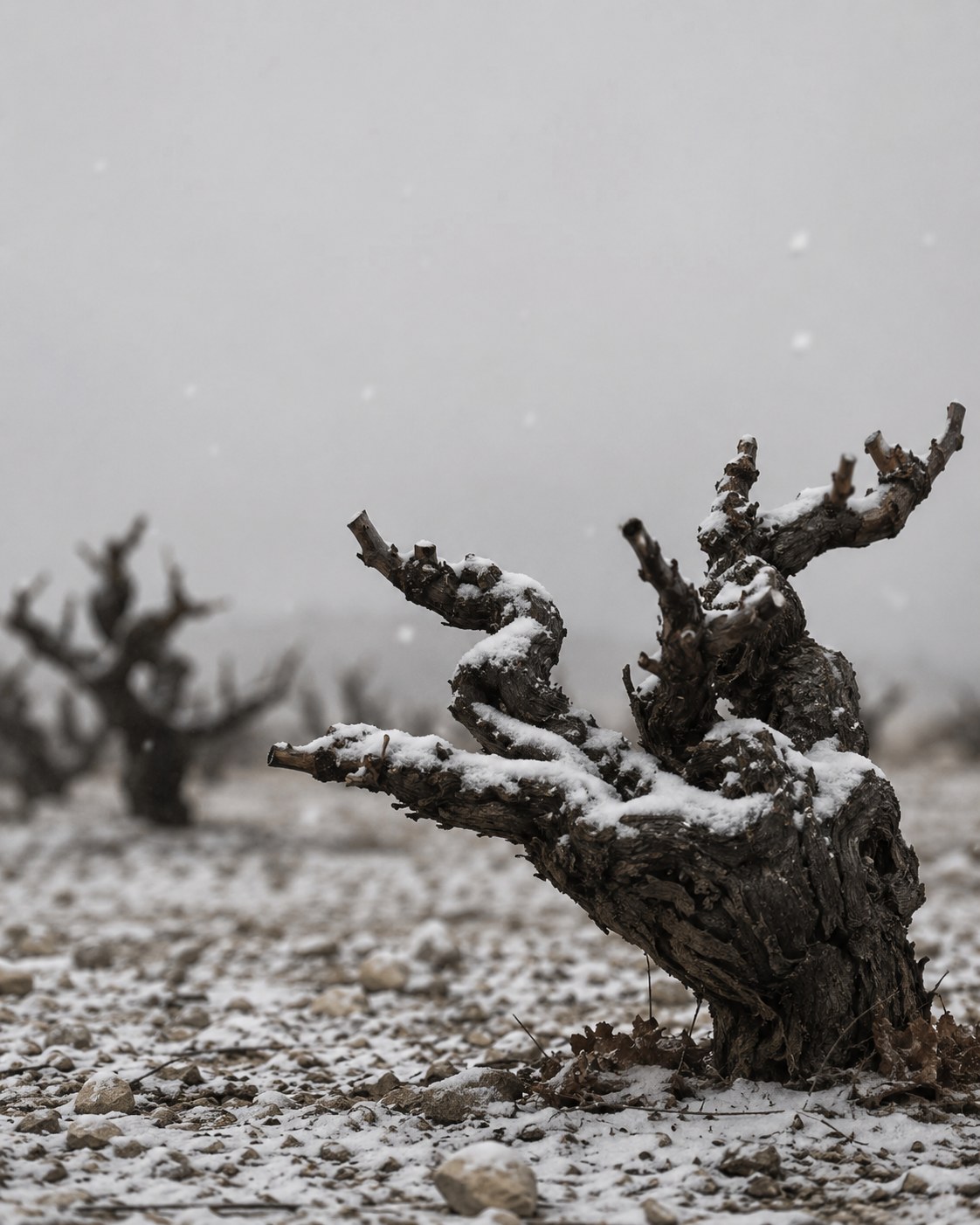
From November onward, the elms stand bare and the vineyard becomes a drawing of vertical lines over brown earth. The year's first silence does not arrive all at once: it slips in slowly, turning off the sounds of harvest one by one -- the belt, the tractor, the early voices in the yard -- until one morning, without warning, all that remains is wind and the dry snap of a leaf still unwilling to fall1.
That is when the real work of the following year begins. While the vine rests on the surface, its roots breathe slowly, the fungi beneath the soil exchange water with the plant, and the winery prepares wood, decisions and forgetting. There is no bottle to show yet, no headline to announce; only an apparently still vineyard and a series of small gestures that will decide, a year from now, how much of the previous year remains inside the wine.
This issue is devoted precisely to those months without an audience -- to what happens when we think nothing is happening.
Vine dormancy is not a metaphor. It is a precise physiological mechanism, governed by temperature and, above all, by the length of the day. In late October, the cambium cells begin producing an inhibiting substance that stops growth. Buds seal themselves, leaves loosen, and the whole plant enters a state of active waiting: neither fully asleep nor awake.
What happens then has the shape of geometry. Each plot, according to its exposure and altitude, enters dormancy at a different time. In Cantosales, facing south at 870 metres, the buds close around November 4. In Los Almendros, forty metres lower and facing north, the process can take several days longer. The difference is not incidental: it conditions the winter pruning calendar, and with it the harvest to come.
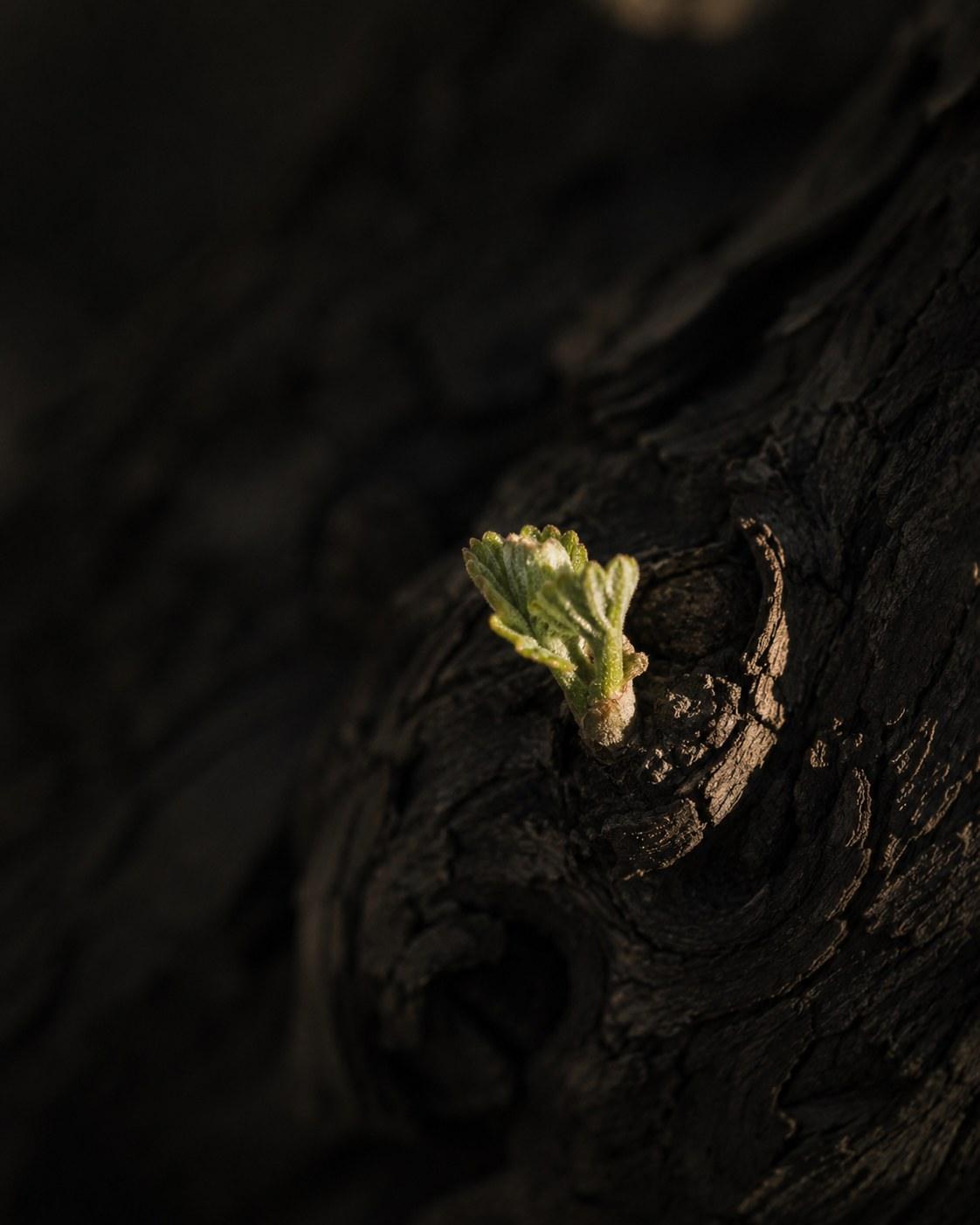
Some winegrowers use accumulated chill units -- measured as hours below seven degrees -- to decide when to intervene. We also trust something less quantifiable: the way the cane cracks when cut2. When it sounds dry and clean, without tearing, the vine has truly entered its pause; we can begin.
"Dormancy looks passive. It is not. It is the only season in which the vine listens to the earth without distraction, and our work, for once, is to avoid interrupting it." — Trifón
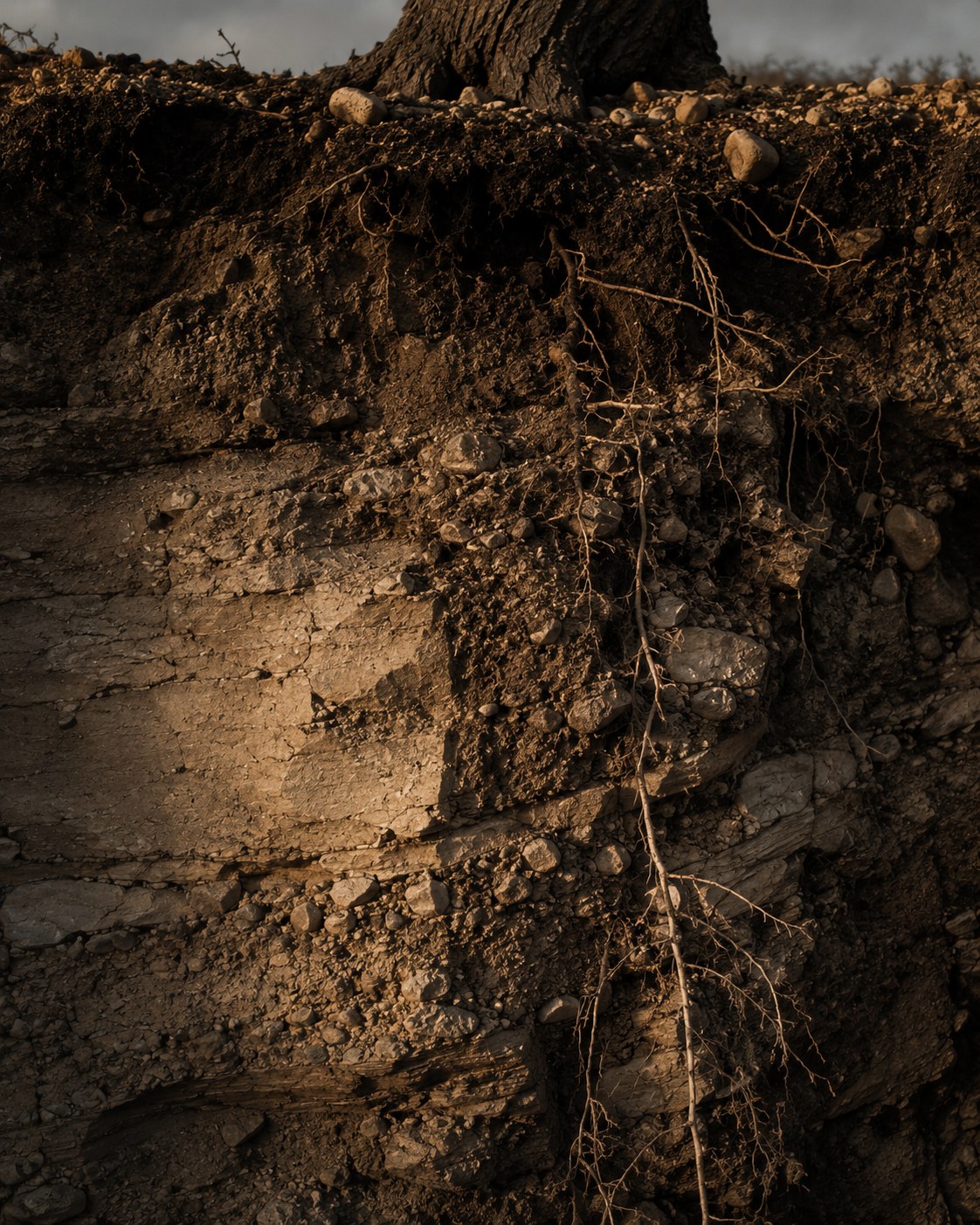
Below the surface, the other half of the year is taking place. The fine roots, the ones that die each autumn and remake themselves each spring, have been reorganizing for weeks. They seek water, yes, but above all they learn the soil: those that find a pore with lasting moisture grow longer; those that meet compact limestone branch; those that encounter a rounded stone simply go around it.
Cooperation with the mycorrhizal fungi beneath the soil -- that invisible network that multiplies each root's effective absorption surface by ten -- intensifies precisely during these months. That is why our old vineyards, planted in the 1960s, withstand droughts that overwhelm younger plots: it is not the plant alone that endures; it is the invisible society around it.
When we speak of terroir, we usually think of mineralogy: limestone, clay, stones. But the terroir that truly matters to wine -- the one that decides persistence, cohesion and elegance -- is built during these months when no one is watching.
To prune a vine is to translate it. Every plant, every year, reaches winter with a story written in wood: long arms, frustrated buds, healed cuts, canes that asked for light in July. Our task is to interpret that biography and decide, in a few seconds per plant, which part deserves to remain and which part is excess.
The guyot pruning we use in Carpio, with a single spur and one long cane, is not an aesthetic choice. It is the answer to a soil that limits vigor; asking the vine for more than two kilos of grapes would be asking it to lie. In La Solana, by contrast, vigor is greater and cordon pruning holds on its own. No single criterion works across every plot, and that is probably the most important thing we have learned in the last three decades.
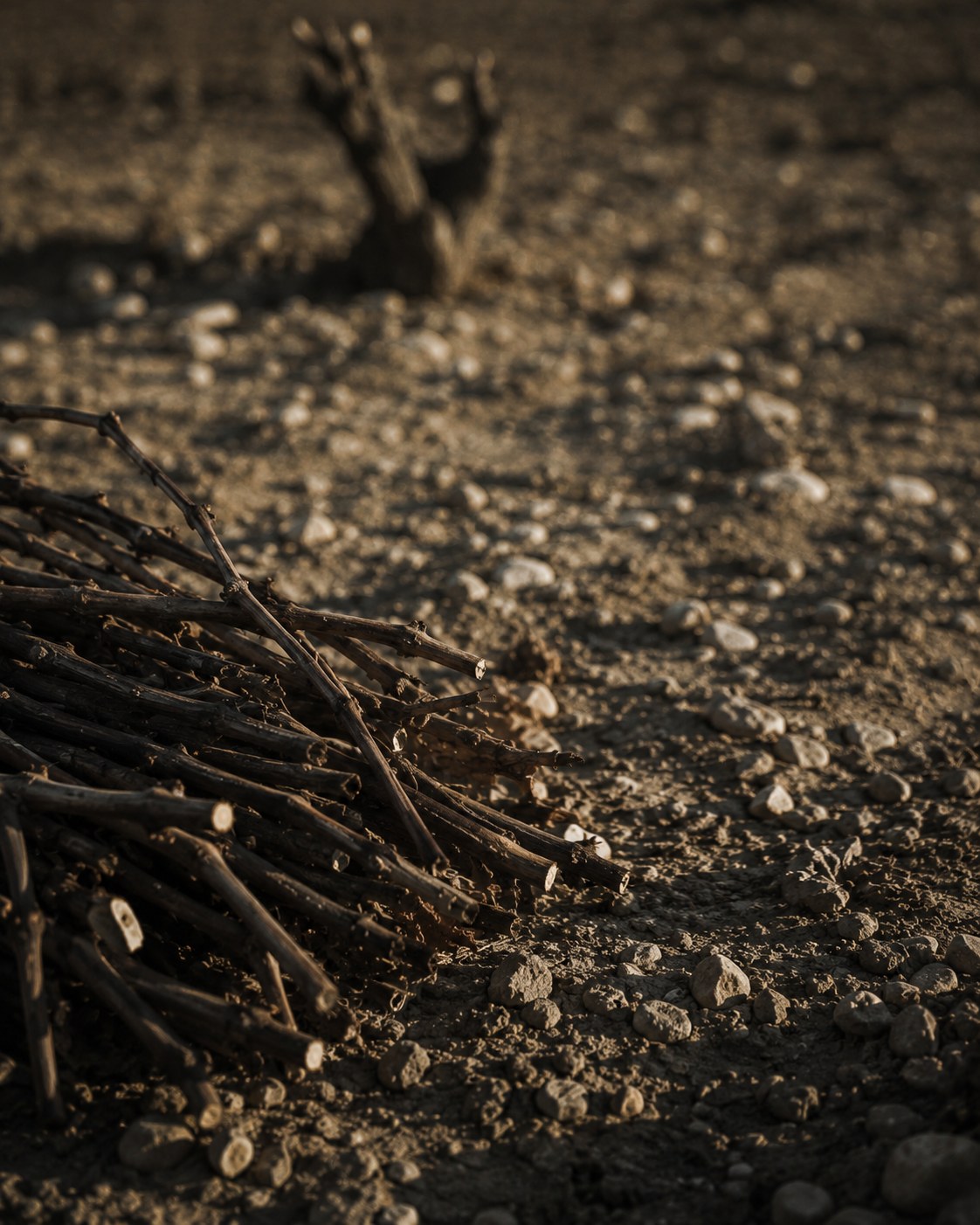
We sharpen the knife at dawn; the cut, slightly angled, lets water run off. Each wound takes three to six weeks to close, and during that time it is an open door for pathogens3. That is why pruning dates are not arbitrary: too early, and the vine will not seal well; too late, and it bleeds. There is a window, different every year, in which the cut closes on its own.
To prune an old vine well is to know how to say no to two thirds of it without losing respect for it. — Notebook of Valdecamellas
A winemaking winter is divided, in truth, into three parallel calendars. The first belongs to the field: pruning, collecting canes, soil analysis, planting young vines where a plant has been lost. The second belongs to the winery: rackings, lees, decisions about which barrel will continue with which lot, and when to bottle. The third -- the least visible -- belongs to the winemaker: going out to the plots first thing in the morning with no tool but the eyes, and beginning to ask questions for which there is still no answer.
In this issue we include a small booklet -- the yellow pages at the end -- with extracts from Valdecamellas's field notebooks between November 1 and February 15. They are not technical notes: they are what she writes when she returns home after spending an hour looking at a plot without doing anything. They are, in other words, the winery's true archive.
Some days the notebook simply says: "today I saw the north wind bring down the remaining leaves with a two-second pause between each one. I do not know what it means. I write it down."
In mid-February, when the first buds begin to swell in the warmest plots, we finish pruning. What remains on each vine -- two buds, three, eight -- is our most concrete decision of the year. From that number will come May's production; from May will come September's grapes; from September will come the harvest. It is the longest chain in the craft, and it begins in silence.
That is why we say, without meaning to sound solemn, that a vintage is decided in September, but signed in February. September is the photograph; February is the formula. One means nothing without the other.
When you see, this autumn, an apparently still vineyard beside a road in Fresnillo de las Dueñas, do not imagine it is resting. It is not. At that exact moment, it is writing a wine you will drink three years from now. And it is writing it without witnesses.