The vine does not wake gently. For five months the bud has been a hard brown scale, sealed with wax and wool, indifferent to anything the weather can do. Then the soil reaches around ten degrees, the sap moves, and in the space of a week that armour opens.
What comes out is the most fragile thing in the whole year: a shoot of water and soft tissue, two or three centimetres long, with no bark and no reserves. It has spent all winter preparing to be invulnerable and it emerges unable to survive two hours at minus two degrees1.
From that moment until the middle of May the crop is hostage to the night. Not the season, not the month: the individual night.
Frost here is rarely a wave of arctic air. It is almost always radiative: a clear, still night after a warm day. The ground gives back its heat to a sky with no cloud to return it, the air in contact with the ground cools, and because cold air is heavy, it slides downhill.
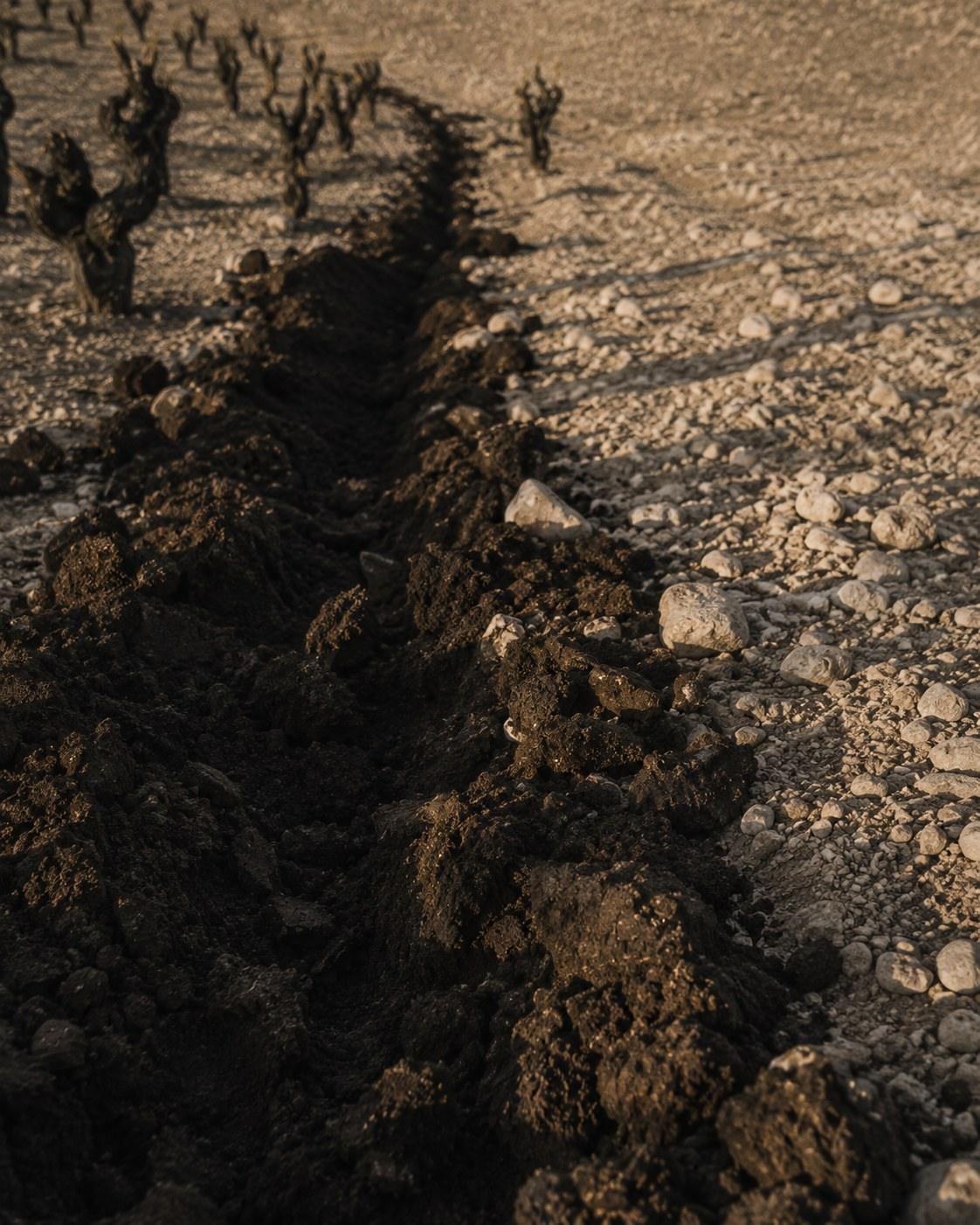
That last part is the whole story. Cold does not settle evenly over a vineyard; it runs, like water, and it pools where water would pool. The plots on the vega, the ones nearest the Duero and lowest in the estate, are the ones that freeze — not because they are colder by nature, but because they are where the cold ends up.
On the same night, a plot on the edge of the páramo at 870 metres can come through untouched while a plot at 830 metres, forty metres below it and warmer by every other measure of the year, loses its shoots. Altitude protects; the bottom of a slope does not.
So somebody watches. From the beginning of April the forecast is read twice a day, and what is read is not the minimum temperature but the three things that make a radiative frost: clear sky, no wind, and a dew point already low in the afternoon.
A dry afternoon is the bad sign. When the air holds moisture, the water condensing releases heat as it does so and the temperature stalls just above zero — the dew saves the shoot. When the air is dry there is nothing to release, and the fall does not stop2.
On those nights nobody sleeps well. The reading that matters is taken at shoot height, not at two metres where the official thermometer sits: between the two there can be three degrees, and three degrees is the difference between a scare and a lost year.
The remedies are famous and mostly disappointing. Candles and braziers work, in the sense that they raise the air a degree or two, and they are unusable at our scale: to protect a single hectare properly takes several hundred of them, lit at three in the morning, at a cost that exceeds what the hectare will earn.
Water sprinkling works better and is stranger: you spray the vines continuously, the water freezes on the shoot, and the act of freezing releases enough heat to hold the tissue at zero. It demands a great deal of water at exactly the wrong moment of the year and a pump that cannot fail for eight hours.
What is left is what was left a hundred years ago: prune late, so the buds open late3; leave the grass short on the frost nights, because bare soil holds and returns more heat than a cover crop does; and accept that on the lowest plots some years will be taken from you.
A frosted shoot is black by mid-morning, limp, and it does not recover. But the vine is not finished, because it did not put everything in the front rank. Behind each main bud sits a secondary, less fertile and slower, which waits precisely for this.
Ten days later the secondaries push. The plant re-grows, the season resumes, and by July a stranger walking the rows would see nothing wrong. The vineyard looks whole.
The crop does not. A secondary bud carries perhaps half the fruit of the one it replaced, sets it later, and ripens it later still — so the frosted plot arrives at the harvest with less fruit, and with fruit that is a fortnight behind everything around it. That is the real cost, and it only shows up in September when the picking dates refuse to line up.
The morning after a frost the job is to walk and count. Not to estimate: to count, plot by plot, marking on paper how many shoots in a hundred have gone black.
It is a bleak walk and it is the most useful hour of the spring, because that number decides everything that follows. Twenty per cent lost and the plot is worked as normal. Sixty per cent and the green pruning changes, the crop load changes, and the picking date will have to be moved.
The count goes into the book with the date and the temperature recorded at shoot height. Years later, when somebody wonders why one plot has behaved oddly for two seasons, the answer is often on that page: a clear, still night in the middle of April.