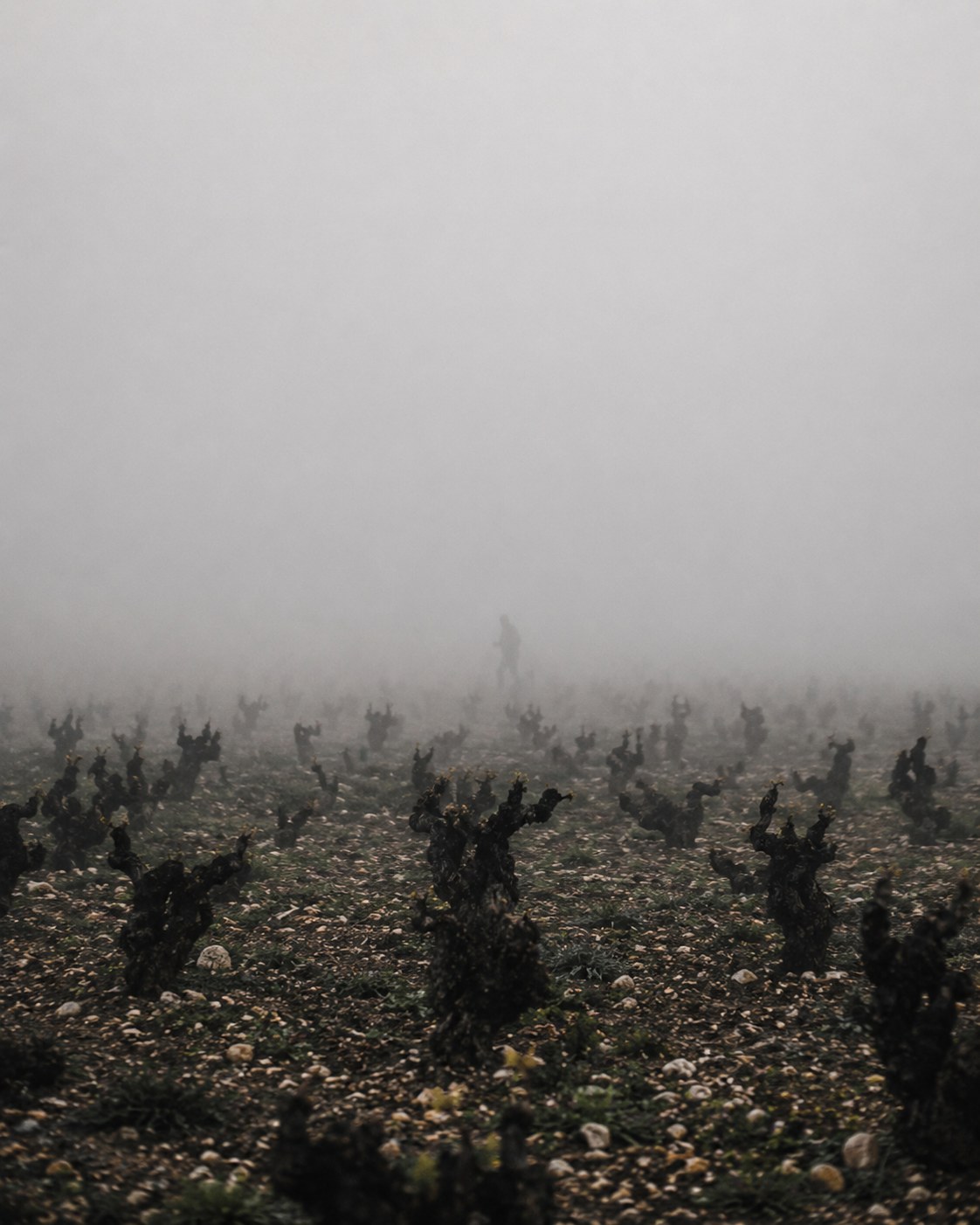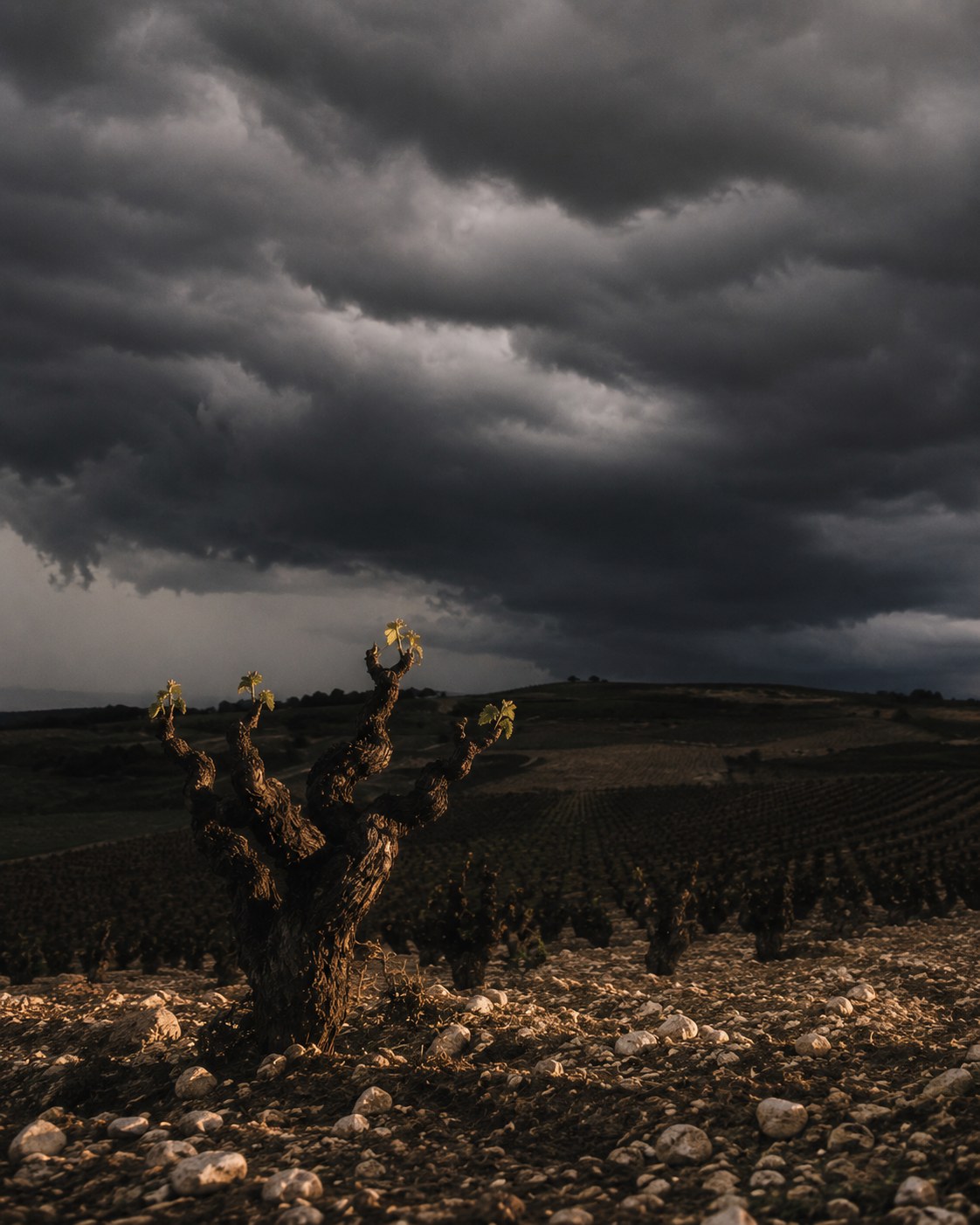
Every description of this appellation contains the same three figures: rainfall between 450 and 500 millimetres, more than 2,400 hours of sun, altitudes from 700 to 1,000 metres1. They are accurate and they are almost useless.
They are useless because they describe a region of more than twenty thousand hectares, and no vine grows in a region. A vine grows on one slope, at one altitude, facing one direction, with a hollow below it and a stand of oaks to the north. The weather it experiences may differ from the regional average by more than the average differs from a neighbouring appellation.
This is not a subtlety. Between our highest plot and our lowest there is a spread of nearly a hundred metres of altitude and, in a normal year, two weeks of harvest date.
Spring frost is the single greatest risk to a vintage here, and it does not fall evenly. Cold air behaves like water: it is denser, it runs downhill, it pools in hollows and sits behind anything that blocks its way2.
The consequence is that a plot at the bottom of a slope can lose its buds on a night when a plot forty metres higher, three hundred metres away, is untouched. The same sky, the same night, two different outcomes.
Over the years those outcomes draw a map, and the map does not change. The same hollows freeze. The same shoulders escape. It is knowledge that cannot be bought or read anywhere: it is accumulated by somebody walking out on the mornings after and writing down what they found.
What this land has, and what almost no warm region can buy at any price, is the difference between day and night in August. Thirty-five degrees at four in the afternoon and thirteen at dawn: a swing that regularly exceeds twenty degrees3.
The mechanism is simple enough. Heat and light by day drive sugar accumulation. Cold by night slows respiration, so the acids the plant made are not burned off before morning. Sugar rises, acidity survives, and the grape ripens without going flat.
That is the whole argument for altitude in a hot country, and it is why a wine from here at fourteen and a half degrees of alcohol can still taste fresh while the same grape grown two hundred kilometres south, at the same ripeness, tastes cooked.
"The weather report is for the province. Each plot has its own opinion, and it is usually different from the one on the radio." — Trifón
The most useful measurements in a vineyard are not the dramatic ones. Nobody needs a record to remember the hailstorm. What is worth counting is the accumulation: how many hours below seven degrees the plant got in winter, how many degree-days above ten it collected between budbreak and veraison, how many hours above thirty-five it endured in August.
Those numbers explain almost everything that a harvest date on its own cannot. Two vintages can be picked on the same day of September and be entirely different wines because one of them accumulated its heat slowly over four months and the other in three brutal weeks.
None of this requires a laboratory. It requires a thermometer in each plot and somebody willing to read it every week for a decade4.
Three things, mostly. The first is that our plots rank consistently. The same ones are always earliest, the same ones always latest, and the order barely shifts even in unusual years. That consistency is what allows a harvest plan to be made in June rather than improvised in September.
The second is that the season has been arriving earlier. Budbreak and harvest have both moved forward, and the gap between them has narrowed — ripening is happening faster, in warmer conditions, which is exactly the condition under which acidity is lost.
The third is that the north-facing plots, which were historically the difficult ones, the ones that struggled to ripen at all, have become some of the most valuable in the house. A slope that was a liability in 1990 is an asset today, and nobody planned that.
There is no intervention in this article. Nothing here can be managed, corrected or improved. The sky does what it does and a vineyard takes it.
What can be done is to write it down, plot by plot, year after year, so that when a decision has to be taken — which plot to pick first, which one to prune shorter, which one to replant and with what — it is taken against a decade of evidence rather than against the memory of last summer.
It is the least glamorous document this house keeps. It is also, at this point, the one that would be hardest to replace.