The oak that will hold a wine for eighteen months began growing, on average, ninety years before anyone thought about that wine1. It grew slowly, in a forest managed by people who would not live to see it felled, and slowness is the whole point: tight rings mean fine grain, and fine grain means the wood gives its tannin gradually instead of all at once.
This is the longest supply chain in the trade and the one least often mentioned. A winery talks about its vine age, its altitude, its yields. It rarely mentions that the second most influential material in the cellar is a tree that somebody planted under a different government.
Of a felled trunk, perhaps a quarter is fit for barrels. The rest becomes furniture, flooring, firewood. The cooper is choosing not just a species but a specific part of a specific tree.
Oak for barrels is split along the grain, never sawn across it. This wastes a great deal of wood and there is no way around it. The tree carries water in vessels that run the length of the trunk, and a saw cuts them open like a bundle of straws: a stave cut that way will weep for as long as it holds liquid2.
Split along the medullary rays instead, the wood is watertight. That is the entire reason a barrel works without glue, sealant or lining — a fact so unlikely that if it had not been discovered two thousand years ago nobody would now propose it.
Everything else about a barrel follows from that constraint. The shape, the number of staves, the way it is bound: all of it is what you get when you insist on building a watertight vessel out of split wood and nothing else.
Once split, the staves are stacked outdoors and left there for eighteen months to three years, exposed to whatever the weather does3. Rain washes out the harshest compounds. Fungi work on the wood. Winter and summer take turns opening and closing it.
Oak can be dried in a kiln in a few weeks instead, and the difference is not subtle. Kiln-dried wood keeps the green, bitter tannins that the rain would have taken away, and a wine aged in it arrives with a hardness that time in bottle does not fully resolve.
So the barrel that arrives at a cellar has already spent between two and four years as a stack of wood in a yard, doing nothing, being rained on. It is the same idea as the vineyard pause, in another trade: the part of the process that consists of waiting is the part that cannot be shortened.
The staves are bent over fire. It is the only way: no steam, no press, no mould — heat and water and a cooper tightening a hoop by degrees over an hour until a flat bundle of wood becomes a curve.
That same fire toasts the inside, and the level of toast changes the wine more than almost any other decision taken in a cellar. Light toast leaves the wood tannic and closed. Medium develops the compounds that read as spice and toasted nut. Heavy pushes towards smoke and caramel and, past a point, towards a flavour that is unmistakably a barrel rather than a wine.
Choosing a toast is choosing how audible you want the oak to be. Our answer, for both wines, is: as little as possible while still doing its work.
"A barrel is not a container. It is a slow window. What matters is not what it gives the wine but what it lets the wine lose." — Valdecamellas
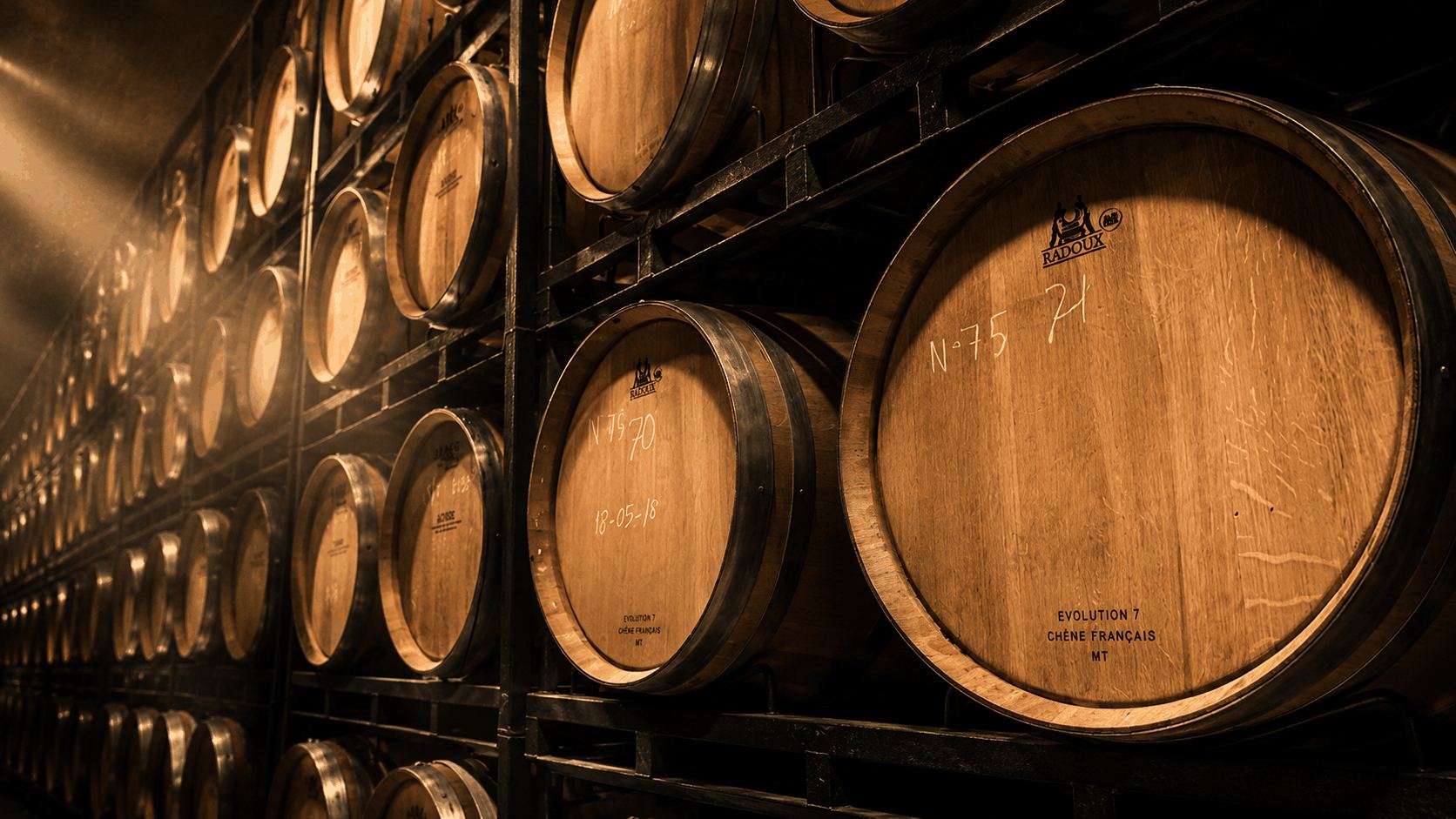
A barrel gives most of what it has in its first year and rather less in its second. By the fourth it contributes almost no flavour at all, and has become something else: a slow, breathing vessel that lets a wine lose a little water and take in a trace of oxygen4.
That second function is the one that matters most and is discussed least. The micro-oxygenation through the staves is what softens tannin and builds texture. It has nothing to do with taste of oak and everything to do with how a wine feels in five years.
Which is why an old barrel is not a worn-out barrel. It is a different instrument, and a cellar that only owns new ones has only one note.
Both wines of this house go into French oak, and in both cases the instruction is the same: be quiet. The red comes from a single plot of old vines on sandy ground and has a shape of its own; the white is made from a variety this appellation only admitted in 2019 and is still being learned. Neither needs a barrel with opinions.
What we want is the window, not the flavour. Time, air in very small amounts, and a vessel that lets the wine settle into whatever it was going to be.
The wood was ninety years growing and three years drying for that. It seems a fair exchange to ask it to keep quiet for eighteen months.