After flowering the vineyard goes quiet. The berries are set by the end of June — small, hard, bright green, sour enough to make your jaw ache — and for six weeks they do very little except grow slowly and stay green.
Then, in the first half of August, one berry on one bunch goes soft under the thumb. A day or two later it has a pink shoulder. Within ten days the whole plot has turned1.
The Spanish word is envero, and it is one of the few pieces of vineyard vocabulary that does not translate cleanly. Veraison is a borrowing that means the same thing and carries none of the same weight.
Up to this point the berry has been building itself: cells dividing, walls thickening, acid accumulating. It has been a growing organ, and a defended one — hard, green, bitter, and no use to any animal that might carry its seeds anywhere.
At veraison the plant switches. Growth by division stops. The berry begins to take in sugar from the leaves instead of making its own, the cell walls soften, water flows in and it swells. Malic acid, which it spent the spring accumulating, starts being burned as fuel2.
The switch is abrupt enough to have a name in the laboratory as well as in the vineyard: before it the berry is a growing organ, after it a storage one. Very little of what happens on either side of that line resembles what happens on the other.
And the skin begins to make anthocyanins, which is the colour. Not painted on: manufactured, in the outer few cell layers, over the weeks that follow. Everything a red wine is looking for lives in that thin shell.
Nobody can name the day a plot changed colour, because berries do not agree with one another. Within a single bunch there will be black berries, pink berries and green ones on the same afternoon.
That spread matters more than the average. A bunch that turned over four days will ripen evenly and can be picked as one thing. A bunch that took two weeks will still, in September, contain fruit at two different stages, and whoever picks it is making a compromise.
The unevenness has a cause worth knowing. A berry turns when it has received enough of what the leaves above it are sending, so the bunches on the shaded inside of the vine turn days after the ones on the outside — and a badly arranged canopy shows up here, in August, for the first time.
So the walk in August is not looking for colour. It is looking for uniformity of colour, which is a different and more useful question.
Veraison is the end of the season's agency. Before it, a grower can still change the outcome: drop fruit, open the canopy, adjust the load. After it, almost nothing done in the vineyard will alter what is in the berry.
Which is why green harvesting — cutting off part of the crop so the vine concentrates on the rest — is done now and not later. Done at veraison it genuinely redirects the plant. Done three weeks after, it mostly wastes fruit3.
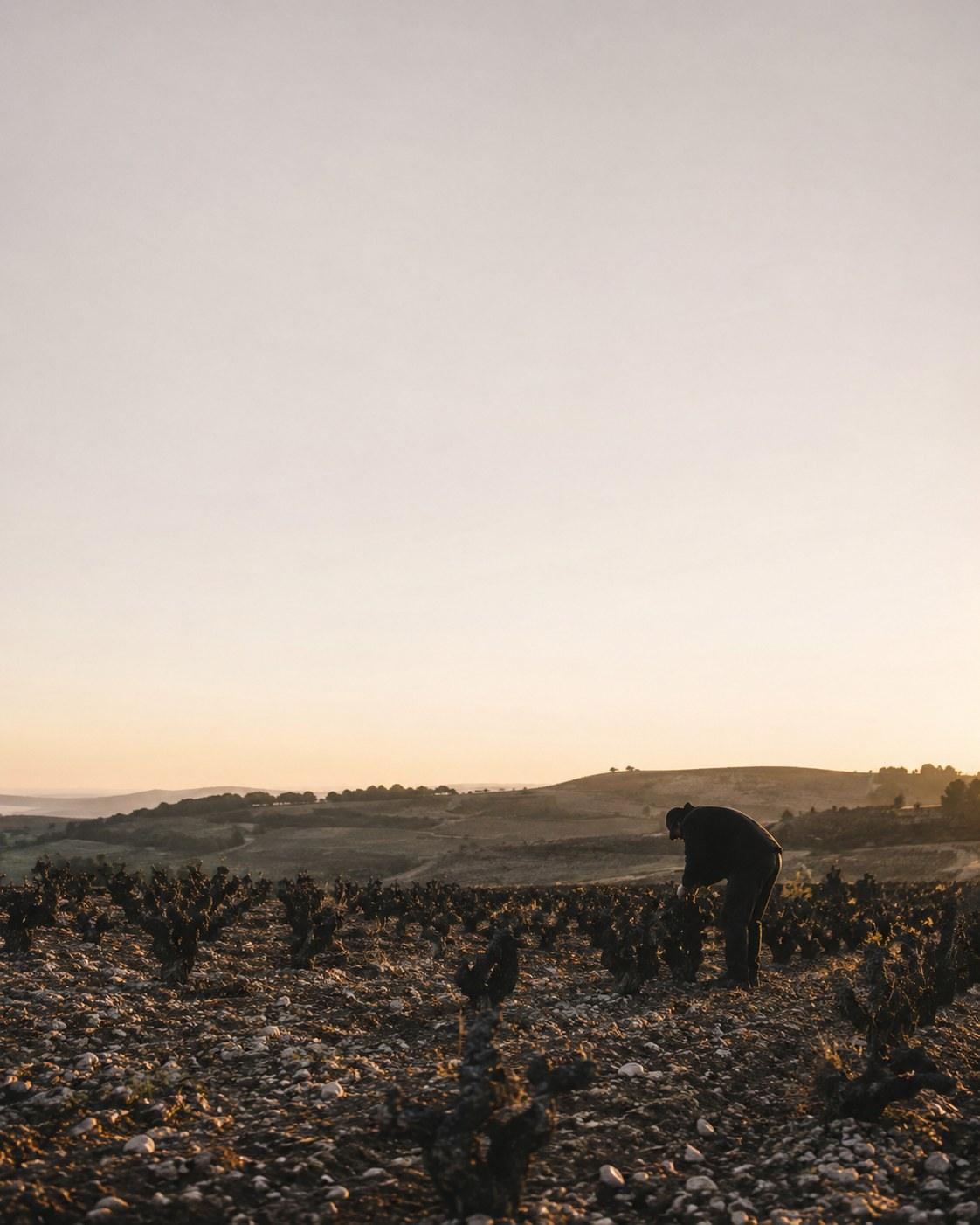
On our plots it is rarely needed. Old bush vines on poor ground at nine hundred metres do not overcrop; the problem here is more often the opposite one. But the plots that were frosted in April sometimes carry an uneven load, and those are looked at now.
Colour runs uphill on the same schedule as everything else. The low, warm, stony plots of the vega turn first, in the first week of August. The plots on the edge of the páramo, forty metres higher, ripen later.
That gap is not a nuisance. It is the reason the harvest can be walked plot by plot instead of all at once, and it is what makes it possible for a house this size to pick nineteen lieux-dits each at its own moment.
From the moment of veraison the calendar becomes real. Add roughly fifty days and you have the first honest guess at a picking date — a guess that will be revised a dozen times and is, for the first time in the year, based on something the fruit has actually done.
A berry at veraison is worth eating, once, so that you know. It is soft and sweet on the tongue and then viciously sour underneath, and the skin is bitter and grips.
It tastes, in other words, like three separate unfinished things: sugar arriving, acid leaving, tannin not yet resolved. Over the next fifty days those three will move at different rates, and picking is the act of choosing the day on which their disagreement is smallest.
That is the whole of ripening, and it starts in a week in August that almost nobody visits the vineyard to see.